

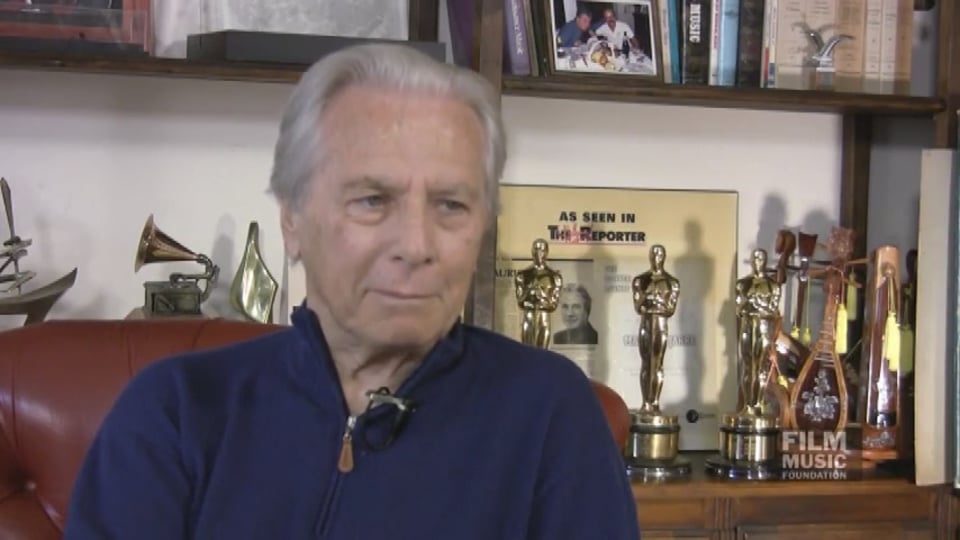
Interview by Jon Burlingame
Maurice Jarre recalls first hearing classical music at 16, on records brought home by his father, technical director of a radio station in Lyon, and deciding to become a conductor. He started solfège in a class of small children, studied percussion with Félix Passerone at the Paris Conservatory, and learned about ethnic music from Maurice and Ginette Martenot. He spent four years with Pierre Boulez playing for Jean-Louis Barrault’s theater company, then about 12 years as musical director of the French National Theater under Jean Vilar.
Seeing one of those productions, Georges Franju asked him to score a short film, which led to Franju’s Eyes Without a Face and Judex. He tells how Sam Spiegel hired him for Lawrence of Arabia while planning to use Khachaturian and Britten, then Richard Rodgers, until David Lean heard Jarre’s own theme: “This chap, he should write the music.”
He describes three rejected Lara themes for Doctor Zhivago before Lean told him to take the weekend off; on Monday he wrote it in an hour. He recruited balalaika players at a Los Angeles Russian Orthodox church, used eight harps on Ryan’s Daughter, and scored the Garden of Statues in A Passage to India. He also discusses Hitchcock’s Topaz, John Huston’s The Man Who Would Be King and Peter Weir’s Witness and Dead Poets Society.
On the craft, he says the hardest part is finding the first five notes; after that, “it’s like cooking,” with “a little touch of percussion like Tabasco.” His greatest pleasure has been his relationships with directors and work with orchestras.