

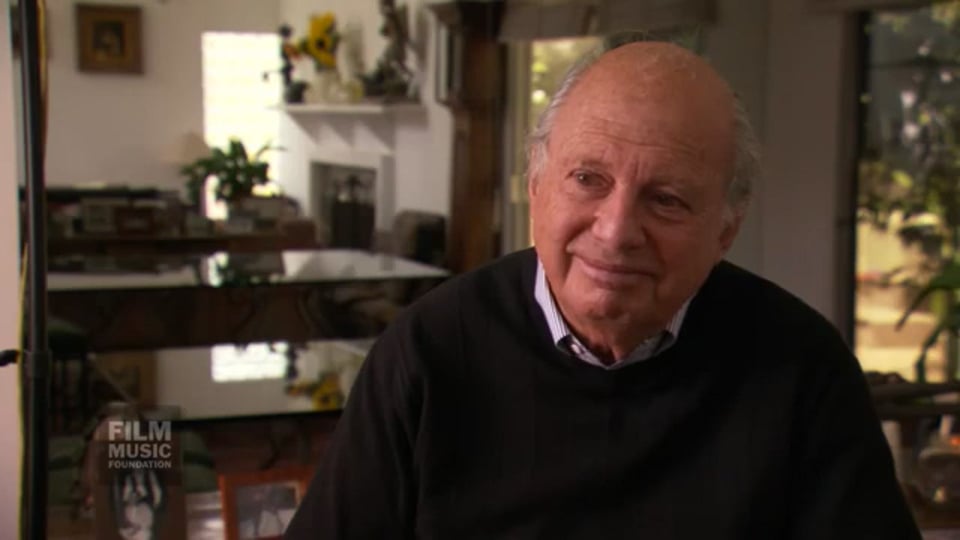
Interview by Jon Burlingame
Recorded May 12, 2009
Laurence Rosenthal describes a Detroit childhood among amateur musicians, starting piano with his mother before he turned four, and a pull toward medicine that ended when his father told him he would never be happy as an amateur weekend musician. After Eastman, where he studied with Bernard Rogers and Howard Hanson, he spent two years with Nadia Boulanger. Drafted into the Air Force, he became composer for its documentary film squadron, learning film scoring from Frank Skinner’s book Underscore.
In New York, Leonard Bernstein’s support led to work for producer David Susskind, including A Raisin in the Sun. He calls The Miracle Worker the score he would keep above all others, recalling hollow clarinets in thirds for Helen Keller’s inner world and a dinner bell echoed by a thousand bells. With director Peter Glenville he made Becket, his first Oscar nomination, where a playback mistake layered Gregorian chant under his cue, and The Comedians.
He also discusses his Return of a Man Called Horse theme, built from European harmony and the falling fourths of Lakota chants; coaching Sophia Loren for Man of La Mancha; Clash of the Titans with the London Symphony Orchestra; the Fantasy Island theme; Peter the Great; and five years on The Young Indiana Jones Chronicles, a job he was told came from John Williams recommending him to George Lucas.
Reflecting on the craft, he argues that a scene should have music only when it can’t do without it, since “Silence is its own kind of music.” He hopes to be remembered for music that would “touch people’s hearts.”