

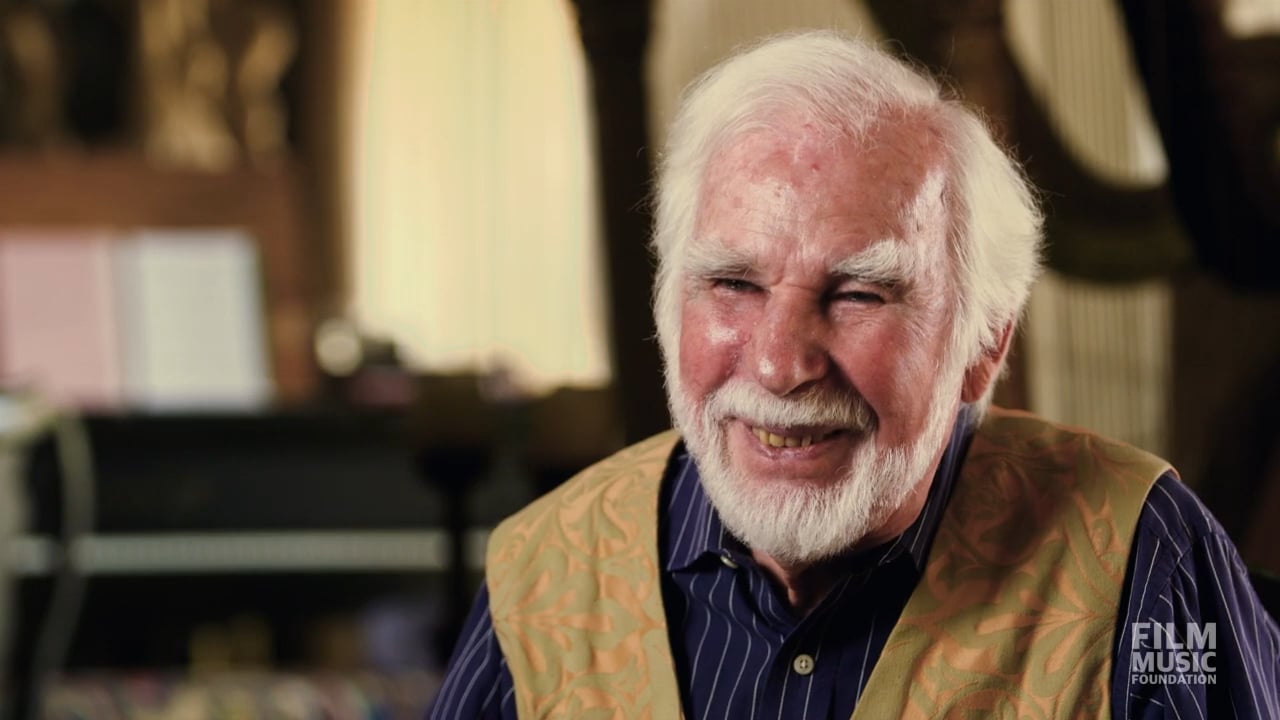
Interview by Jon Burlingame
John Scott, born in Bristol, England, in 1930, describes his circus-musician father and his mother, a soubrette, dancer and contortionist. He disliked the violin but took to the clarinet “like a duck on water,” and at 14 joined the army’s Royal Artillery Band as a boy musician, where he was made to play harp. After leaving in 1952 he toured with dance bands. When Bell’s palsy left him unable to close his lips to play the saxophone, he took up the vibraphone rather than leave music, then took up the flute while playing in a ballroom band in Belfast. By the late 1950s he was a session player.
He recalls leading the whistlers on piccolo for The Bridge on the River Kwai, Muir Mathieson’s gift for fitting music to picture, playing on Dr. No and the improvised saxophone solo in Goldfinger, and watching Henry Mancini work. He played flute on the Beatles’ “You’ve Got to Hide Your Love Away” and arranged for the Hollies and Cilla Black. Herman Cohen saw Shellorama, a large-format short Scott scored for Shell Oil that was shown before How the West Was Won, and hired him for his first feature, A Study in Terror.
He describes writing Antony and Cleopatra for Charlton Heston in three or four weeks, scoring Ted Kotcheff’s Wake in Fright with a cardboard wobble board, and coming late to Greystoke, which Hugh Hudson saw as a tragedy. He also covers Indian-flavored scores for The Long Duel, Mountbatten and The Deceivers; years of documentaries for Jacques Cousteau, who told him, “I want your music”; and concert works, including string quartets and a ghost opera.
On the craft, he says film music should manipulate the audience without their knowing, insists that orchestration “is part of composition,” and calls music “the love of my life.”